
New Trine University programs offer quicker pathway to careers
October 14, 2026
Students who want to become pharmacists or construction managers will soon have a quicker, more cost-efficient pathway to those careers.
1/3
August 12, 2026
Michael Smith, assistant professor of mathematics, and Joanna Claudy, assistant professor in the Department of Humanities and Communication, spoke during Trade Day at the recent Gen Con in Indianapolis.
Held on the first day of Gen Con, which was from July 29 to Aug. 2, Trade Day features academics, librarians and other professionals presenting on the uses of gaming in education.
Smith and Claudy both presented for the second year in a row.
Fitting lessons, building skills
Smith’s talk, “Modifying Games to Fit Lessons,” used the commercial game Berrymandering to demonstrate ways educators can adjust the rules of an existing commercial board game to meet the learning objectives of a course.
Claudy’s presentation was titled “Games and Activities for Intercultural Skills” and involved participants playing games she uses in her own Interpersonal Communications class at Trine.
The two each attended other sessions, including talks about Indiana University Indianapolis’s Media Arts and Science Research and Learning Arcade (MARLA), having students create games as a learning activity, games that teach communication and ideas for applications to theater, logic, topography and more.
Throughout the rest of the convention, both Smith and Claudy continued to gather ideas, obtain donated games and network.
Claudy participated in a class on silicone molds and resin models that she plans to incorporate into her fall theater course. Both play-tested String Theory, an upcoming project by Tessellation Games, that has education applications in media podcasting, persuasive speech, information theory and geometry.
Tessellation Games is also the maker of Berrymandering and previously partnered with Trine faculty to support last fall’s Art of Games event.
Building a game library
On the final day of the convention, Smith was also able to speak with publishers about supporting a board game library at Trine.
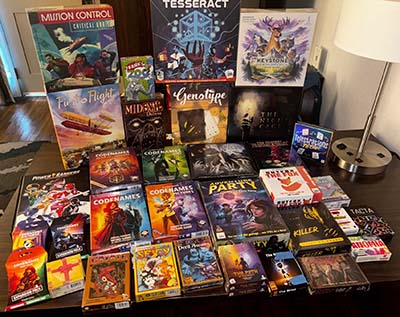
“Both of our classes have been utilizing board games for several years now, but that’s mostly been our personal collection,” Smith commented. “We want students to have more access to the breadth of games if they can find value or learning by playing them. It turns out, most gaming companies agree and were eager to offer games for us to bring back!”
Claudy estimates the 33 games donated have a commercial value of $716. The games will be added to Claudy’s existing collection in the Department of Humanities and Communication, but she is hopeful they won’t just be valuable to her.
“A big part of the convention was seeing how many areas could benefit from games as a learning tool,” she said. “I want to provide faculty across campus the chance to borrow games to help students engage in learning objectives.”
“As one talk put it, we want to think about what mechanics help students implement and practice what they are learning and find a game that fits that goal. Alternatively, we can also use games to introduce students to a concept, then pull those examples through the learning, like Professor Smith does in Probability with Panda Royale, a dice drafting game.”
Trine faculty interested in borrowing games should contact Claudy, although she hopes to provide additional ways to access the collection in the future.
Smith also plans to connect colleagues to other attendees or games that might suit their interests.
“The folks at IUI were keen to connect with some of the faculty at Trine. I’m making introductions via email in the coming weeks,” he said.
He said he also found a few games and resources that don’t fit in mathematics that he hopes other STEAM faculty can make good use of.
After Gen Con, Smith and Claudy volunteered to judge at the Indiana State Fair before returning home. This is the third year they’ve judged State Fair.
“Learning happens when students are engaged. Whether that’s games or independent projects, we want to support that education,” Smith said.
Students who want to become pharmacists or construction managers will soon have a quicker, more cost-efficient pathway to those careers.
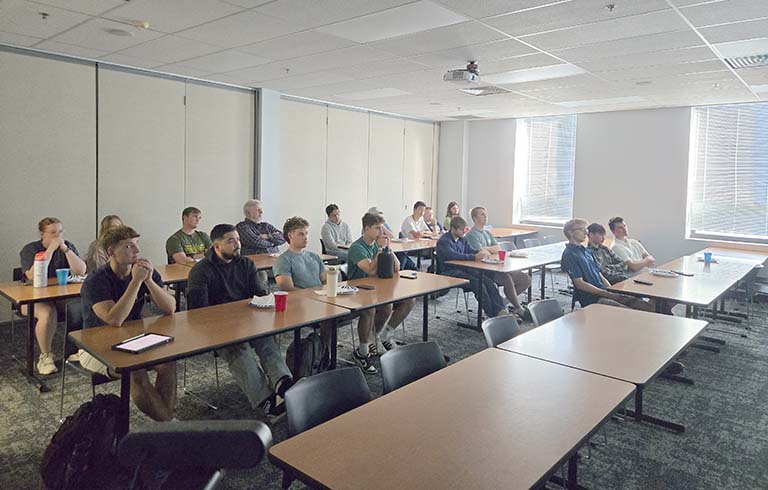
The head of the Indiana Department of Transportation (INDOT) joined Trine University students remotely to help launch its new Transportation & Development Institute (T&DI), part of the American Society of Civil Engineers (ASCE).

Jeremy Goossens, director of esports and industry innovation at Trine University, was named Director of the Season by ECAC Esports, the comprehensive collegiate esports league where Trine competes, for spring 2026.