The Bachelor of Science in computer engineering at Trine University provides you with
the best possible tools to integrate hardware and software, with an emphasis on computer
hardware across all levels. You will gain industry-ready skills and be prepared to
step into the workforce or graduate school with a broad range of technology skills.
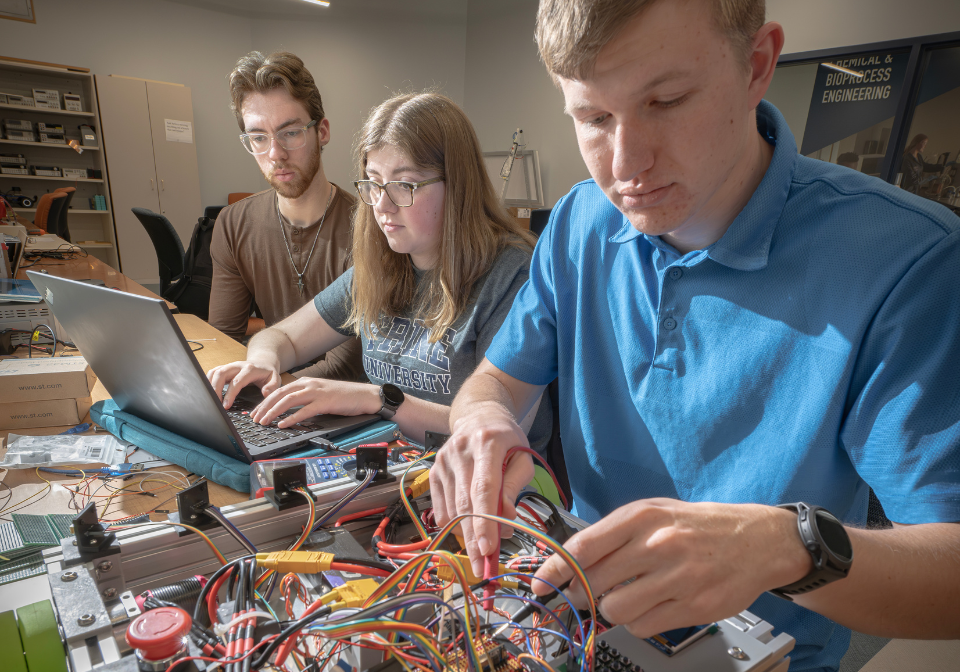
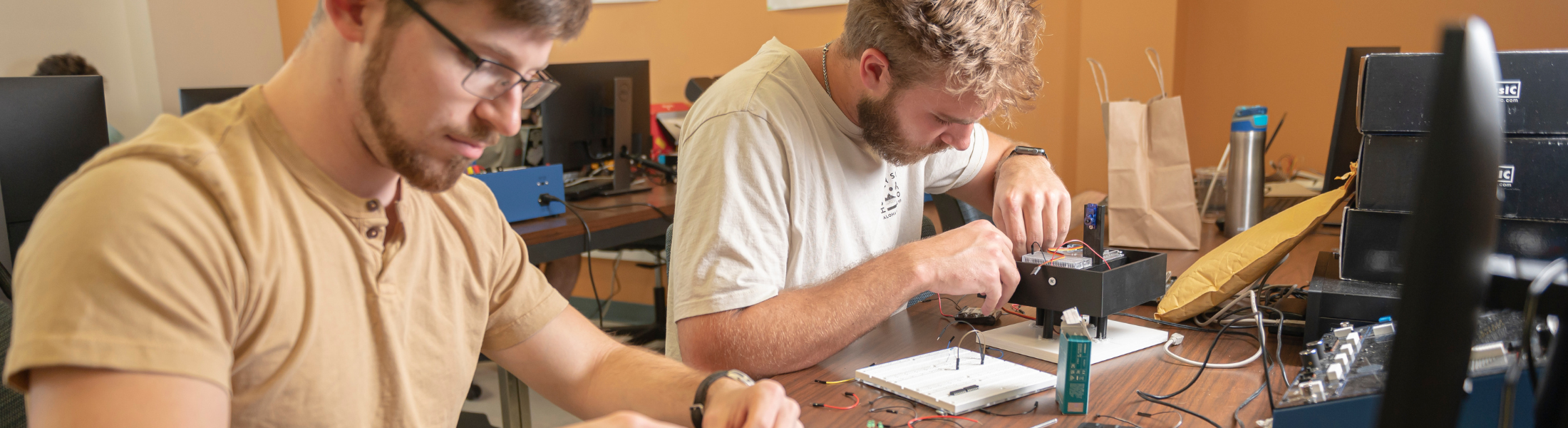
Trine's Bachelor of Science in computer engineering prioritizes firsthand experiences
through over 10 labs and project-based learning. You will begin with the basics, such
as prototyping circuits in boards, and gradually build your skills and your portfolio
by practicing more challenging concepts. The program's curriculum is designed to expose
you to a major-related lab as early as your first semester.
As a computer engineering student at Trine, you will haveaccess to labsthat house:
Three-phase electrical power supplies
Electrical loading elements
Electrical motors and generators
Instrumentation to monitor voltages, currents and power
Multimeters
Four-channel oscilloscopes
Prototyping boards
Computer for simulation and data acquisition tools
Logic analyzers
ARM Cortex-M microcontrollers
Apps such as Git, GCC/G++, IDEs, FPGA Boards DEO and DE1/
Quartus Simulation Software for digital design
Softwares such as C++, C, C#, Python, JavaScript, ASP, PHP, Linux, Mysql, Ruby, KOLTIN,
Jason script, XML and more
During your time as a biomedical engineering student at Trine, you willexperience:
Digital logic and computer architecture
Programming languages and algorithms
Embedded systems and Internet of Things (IoT) design
Networking, cybersecurity and communications
At Trine, your computer engineering "classrooms" look like engineering workplaces.
The program utilizes state-of-the-art lab spaces and an industry-relevant curriculum.
Logic and Computer Design Laboratory: Design and implement design concepts in Field Programmable Gate Arrays (FPGAs). Verify
and design combinational circuits, sequential circuits and state machines using HDL
and schematic tools and implement the design in an FPGA. Work in a group setting to
come up with a challenging project, design and implement the project in an FPGA and
demonstrate and present the design.
Embedded Systems Laboratory: Develop a modular, cooperative system to meet timing requirements. Experience an RTOS.
Use tools and patterns of modern embedded systems to implement designs. Assess and
approach compliance to a coding standard for mission-critical systems. Work in small
teams using version control. Assume responsibility for designing the tests or experiments
needed to verify work.
C++ and Object-Oriented Design: Use pointers, arrays, header files and functions of the standard library. Overload
operators. Determine a plan for testing a piece of software and organize a program
to determine classes and objects. Design a graphical user interface using a GUI tool
kit.
The average class size for the Bachelor of Science in computer engineering is20 studentsin freshman and sophomore courses. That number decreases to10-14during junior and senior year.
As a computer engineering student, you will receive theundivided attention from expert faculty. The small class sizes will allow you to createimportant relationshipswith experienced mentors in the field.
Knowledge and tools to succeed in professional life
The Bachelor of Science in computer engineering delivers a broad foundation so you
can succeed in various professional paths. Whether you want to design the next generation
of smart devices, learn large language models for AI, engineer life-changing medical
technology or develop software, you will be equipped with right skillset upon graduation.
Trine graduates will be prepared for the followingcareer possibilities:
Embedded systems engineer
Graduate study in computer engineering, computer science or a related field
Hardware/software integration specialist
FPGA/ASIC designer
Network and systems architect
Robotics and automation engineer
Companieslikely to recruitTrine graduates include:
BAE Systems
L3Harris
Peakey Enterprises, LLC
Texas Instruments
Ultra Electronics
Accreditation
Trine University's computer engineering program is accredited by theEngineering Accreditation Commission of ABET, under the commission's General Criteria and Program Criteria for computer engineering.
Top-of-the-line equipment, extensive lab exposure. Trine's senior computer engineering
students showcase a culmination of their experiences and knowledge with a year-long
design project.
1/8
The Autonomous Sumo Robot was designed to meet the rules of the 2026 National Robotics
Competition, requiring the robots to fit within a 20-inch cube and weigh less than
20 pounds. The robot operated without human input and competed in a head-to-head match.
The match challenges the robot to detect, track and push the opposing robot out of
the ring. This design used five Time-of-Flight sensors for continuous measurements
to locate and track the opposing robot. The robot also included a user interface made
up of a display and button matrix, allowing the user to select different modes.
2/8
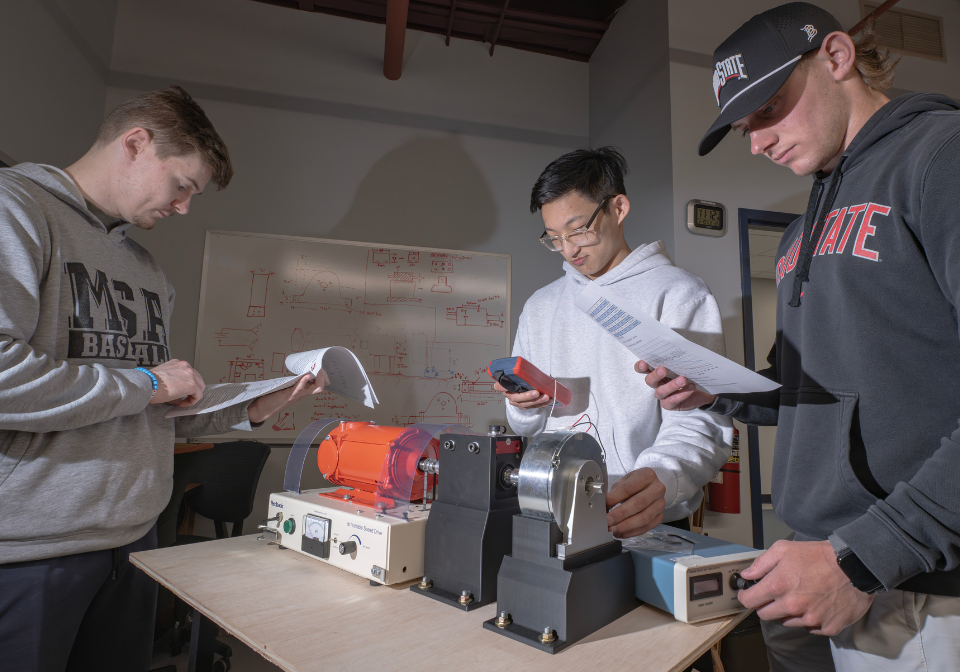
The team designed and built a new extension of the motor system within Trine's power
lab, which completely replaced the old setup. This system is directly connected to
the existing induction motor and mechanically attached to the motor shaft. The new
system allows for graphical displays of the input electrical power, torque, current
and speed as functions of time.
3/8
The Micromouse Robot was an autonomous system designed to compete in the 2026 National
Robotics Competition (NRC). It fit within a 7 inch by 7 inch by 7 inch volume, was
battery powered and navigated a 10 by 10 maze. The robot used wheel encoders, IR sensors
and a nine-axis IMU for position estimation and implemented path-planning algorithms
to determine and execute the optimal route.
4/8
Building on the team of robots that have been created over the last few years, this
year's team added a running back robot for the robotic football team. This robot is
wirelessly controlled by a handheld remote. The robot contains a mechanism for holding
a small football and a robust design containing multiple motors to allow for high-speed
play against other teams in the Collegiate Robotic Football Conference.
5/8
This project focused on designing and building a single-phase SPWM inverter that converts
a low-voltage DC input into a controlled AC output. The inverter utilizes a microcontroller,
voltage sensors, current sensors, buck circuits, gate driver, H-bridge MOSFET stage,
LR filter and a step-up transformer supplied by the machines lab. The goal was to
build a system that can reliably power inductive loads while demonstrating inverter
behavior at several different power factors.
6/8
This project proposed the development of a web-based application designed to provide
a voting system for a high school soccer team association. The system supported 10
divisions, each consisting of between three and 40 teams, and was capable of handling
up to 200 concurrent users during peak voting periods. To ensure a fair and structured
process, the application operated in two distinct phases. In the first phase, coaches
within each division nominated players for designated honors. In the second phase,
coached reviewed the submitted nominations and casted their votes.
7/8
This project was a portable solar-powered charging station designed for outdoor, emergency
and off-grid use. It included a 100W solar panel, rechargeable battery, MPPT charge
controller, inverter and microcontroller enclosed in a weather-resistant casing. The
system provided two 120V AC outlets capable of charging four devices. A microcontroller
prioritized solar energy and automatically switched to battery power when output was
low. Built-in protections prevented overcharge and low voltage, while continuous monitoring
ensured reliable performance in varying conditions.
8/8
Virtual pinball machines provide a modern, affordable alternative to traditional pinball
tables, which often cost between $5,000-$20,000 and require extensive maintenance.
This project presented a virtual pinball machine built for just over $1,000 that digitally
recreated classic game play using a monitor-based playfield, virtual components and
optional physical features like a real plunger. Tactile feedback and online score
tracking modernized the pinball experience while preserving its timeless appeal.
What Can You do With This Degree?
Technical excellence is required when working on space-based systems. The work quality required, and the incredible systems I get to design and implement make work fulfilling.
The Trine University music program will open its 2026-2027 concert season with the return of its annual “Halloween Haunt-cert” at 3 p.m. Saturday, Oct. 24.
Eight faculty from Trine University’s Allen School of Engineering and Computing recently participated in the American Society for Engineering Education’s (ASEE) annual conference, with several publishing and presenting papers.
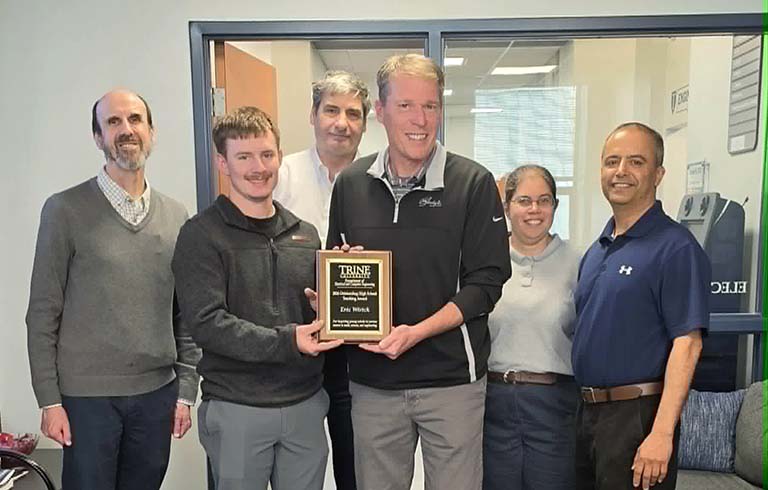
Trine University’s Department of Electrical and Computer Engineering recently presented its annual Outstanding High School Teaching Award to Eric Wirick, a teacher at Fremont High School.

 Trine University's computer engineering program is accredited by the Engineering Accreditation Commission of ABET, under the commission's General Criteria and Program Criteria for computer engineering.