Ansys grant allows Trine engineering faculty to expand simulation-based learning
December 08, 2025
Share
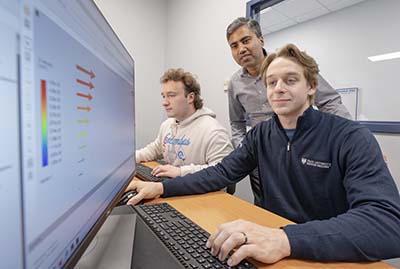
Trine University students Luke Arnold, left, and Josh Danielowski work with Ansys
Fluent software under the supervision of Gurudutt Chandrashekar, Ph.D., associate
professor in Trine University’s Wade Department of Mechanical and Aerospace Engineering.
(Photo by Dean Orewiler)
Trine University has received grant funding from Ansys, an engineering simulation
and 3D design software company, to expand simulation-based learning across key mechanical
and aerospace engineering courses.
Led by principal investigators Gurudutt Chandrashekar, Ph.D., and Rizacan Sarikaya,
Ph.D., both associate professors in the university’s Wade Department of Mechanical
and Aerospace Engineering, the initiative integrates Ansys Fluent, Workbench and Discovery
into the curriculum to give students hands-on experience with the tools used by engineers
in industry.
Ansys Fluent is a computational fluid dynamics application used to simulate physics
phenomena such as fluid flow and heat transfer. Ansys Discovery is 3D-simulation software
that combines physics simulation, high-fidelity simulation and interactive geometry
modeling.
Ansys Workbench integrates multiple Ansys tools into a single environment.
The applications will be used in the following classes:
Fluid Dynamics. Students will simulate combined Couette–Poiseuille flow to study velocity
gradients and wall shear stress.
Heat Transfer. Students will model the transient cooling of a quenched sphere.
Mechanical Measurements: Students will compare experimental pipe-flow pressure-drop
data with Ansys Fluent results, directly linking laboratory testing to computational
modeling.
Aero Materials: Fatigue testing will be performed using a rotating fatigue machine
to generate S–N curves for steel, aluminum and brass. The data will then be imported
into Ansys to conduct a fatigue analysis of an aircraft wing spar, allowing students
to visualize fatigue-prone areas and understand how cyclic loading affects structural
life.
Mechanical Engineering Design I and II: Senior design students use Ansys Discovery
and Workbench to optimize the AIAA Design-Build-Fly aircraft and Shell Eco-marathon
vehicle, improving structural strength, aerodynamics and weight efficiency.
“These activities all help students bridge theory, experimentation, and simulation-based
design,” said Dr. Chandrashekar.
Trine University received a $4,250 grant for 2025-26 and a $4,500 grant for 2024-25.
Ansys allows educators to submit proposals to create innovative curricula or improve
existing courses in undergraduate engineering departments by implementing Ansys simulation
tools.
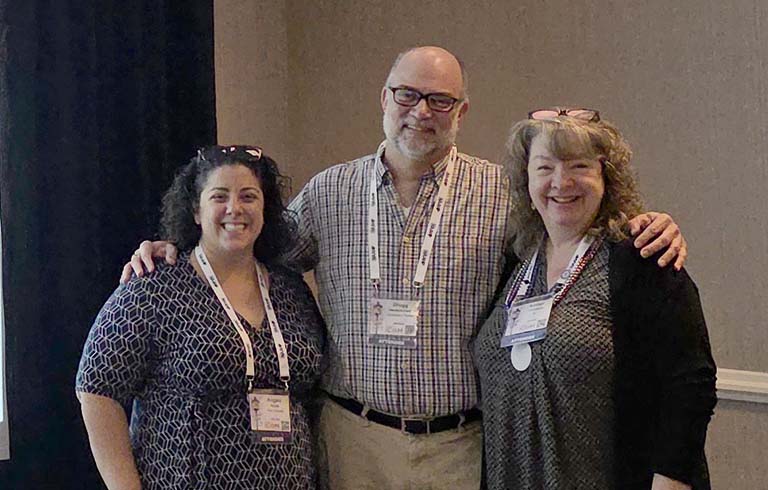
The director of Trine University’s pre-health professions and direct entry programs was part of a team that presented updates to best practices for health professions advisors and institutions at a national conference.
A faculty member in Trine University’s Allen School of Engineering and Computing has received a $5,000 grant to write an open education resource (OER) textbook for a new class to be offered beginning in the fall.